The following article summarizes Xi Jinping’s speech at a Chinese Politburo study session on internet censorship in November 2025. Xi’s remarks indicate that the Party continues to worry about its ability to maintain control over online discourse in China. However, Xi appears to view AI technology as more of an enabler for than a threat to the Communist Party’s control over the Chinese internet.
An archived version of the Chinese source text is available online at: https://perma.cc/8RJV-BQD6
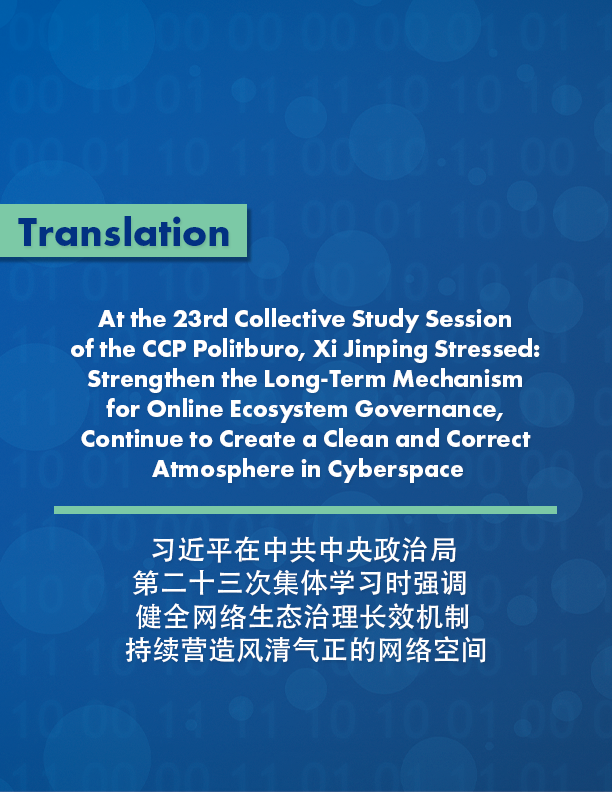
At the 23rd Collective Study Session of the Chinese Communist Party Central Committee Politburo, Xi Jinping Stressed: Strengthen the Long-Term Mechanism for Online Ecosystem Governance, Continue to Create a Clean and Correct Atmosphere in Cyberspace
Beijing, November 29 (Xinhua News Agency): The Politburo of the Central Committee of the Chinese Communist Party (CCP) held its 23rd collective study session on the afternoon of November 28, on strengthening online ecosystem governance. While chairing the study session, CCP Central Committee General Secretary Xi Jinping stressed that online ecosystem governance is an important task for building China into a cyber powerhouse.1 It is a task that concerns national development and national security, and one that concerns the personal interests of the masses of the people. We must strengthen the long-term mechanism for online ecosystem governance, focus on making governance more forward-looking, precise, systematic, and collaborative, and continue to create a clean and correct atmosphere (风清气正) in cyberspace.
Comrade Shi Jianzhong (时建中), professor at China University of Political Science and Law, gave an explanation of this issue and offered recommendations for work on it. Comrades of the Central Committee Politburo listened attentively to his explanation and engaged in discussion of it.
After listening to the explanation and the discussion, Xi Jinping delivered an important speech. He pointed out that, since the 18th Party Congress, we have placed online ecosystem governance in an important position. We have continuously strengthened mainstream values, mainstream public opinion, and mainstream culture online, and have effectively tackled and contained online chaos (网络乱象). Overall, the online ecosystem is improving. Our practice these past several years has led us to a deep understanding that it is necessary to persist in the Party’s leadership, persist in putting the people first (人民至上), persist in making rule of law the safeguard, and persist in systematic concepts (系统观念) as we undertake online ecosystem governance.
Xi Jinping stressed that online ecosystem governance occupies an important position in national governance. We must concentrate unified leadership in the Party Central Committee, strengthen the online comprehensive governance pattern (网络综合治理格局), and form a concerted effort for governance. All departments at all levels should strengthen their political responsibility and leadership responsibility for managing and governing the internet, while simultaneously effectively solving prominent problems and continuously improving their ability to use the internet to comprehend the will of the people and launch internet-related work. We must strengthen guidance of online platforms, self-media,2 and multi-channel network organizations (多频道网络机构), and spur them to shoulder their social responsibility and consciously become spreaders of positive energy (正能量).
To view the rest of this translation, download the pdf below.
- Translator’s note: Alternate English translations for the Chinese term wǎngluò qiángguó (网络强国)—here translated as “cyber powerhouse”—include “cyber superpower,” “network superpower,” “online superpower,” “internet superpower,” and so on. For a more thorough discussion in English of the meaning of the term wǎngluò qiángguó, see: https://www.newamerica.org/cybersecurity-initiative/digichina/blog/lexicon-wangluo-qiangguo/.
- Translator’s note: The Chinese term “self-media” (自媒体) refers to non-institutional, publicly accessible social media accounts on platforms such as Weixin (WeChat) and Douyin (TikTok) that are typically run by individual users and produce news content.