
Executive Summary
Policymakers are trying to win a race for AI, but neither developing nor deploying technology is a sufficient goal on its own. This brief contends that the goal should be to achieve grander victories such as in economic or military domains, with AI as an enabling technology. Achieving that larger goal demands success in two additional stages beyond AI development and deployment. First, AI needs to provide some specific competitive advantage. After that, policymakers must develop a plan for, or theory of, what constitutes victory, describing how competitive advantages lead to triumph despite an adversary’s efforts to the contrary.
Figure E.1: The Chain From AI Superiority to Winnings Can Break in Many Ways

Source: Author’s analysis.
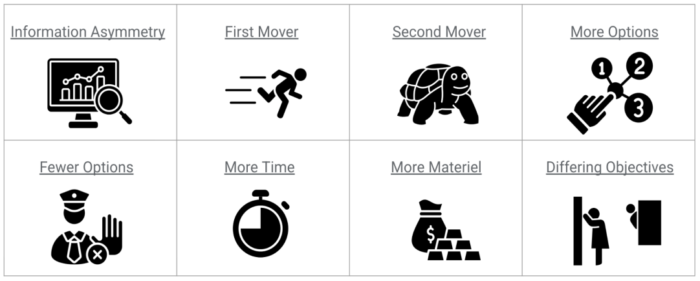
AI can provide many different types of competitive advantages to varying degrees, depending on the application. In some cases, AI will be decisive. In others, it will provide advantages that are only substantial, negligible, or even counterproductive. There are too many possible applications of AI to evaluate each explicitly, so eight different types of competitive advantages are considered here, as listed in Figure E.2. For each type, illustrative examples are provided from game theory, athletics, chess, cybersecurity, or finance, to clarify how an AI advantage can be decisive, substantial, negligible, or counterproductive.
Figure E.2: Eight Different Types of Competitive Advantage Are Considered
Source: Author’s analysis.
Based on those examples, AI is likely to provide some decisive advantages, but the number of decisive cases will be limited by non-AI limitations, bottlenecks, and adversary countermeasures. Additionally, the degree of AI superiority may be too small and fleeting to provide many decisive advantages.
Even a decisive competitive advantage may not be enough to secure victory. Achieving strategic-level goals such as in military conflict, diplomacy, or profit and loss requires another level of prudence. For any specific AI application, there are six categories of theory of victory to choose from.
- Cooperation looks for win-wins, where a rising tide lifts all boats. The supply chain could be spread across partners, and the rewards from AI could be widely distributed rather than fought for.
- Dominance exists when a stronger competitor can enforce its will on a weaker competitor with little recourse. Dominance has been the United States’ primary approach to AI at both the geopolitical and corporate levels.
- Denial prevents adversaries from achieving their goals. Denial has also been a popular theory of victory for the United States in AI through export controls and protection of intellectual property such as model weights.
- Devaluing reduces the benefits of victory in ways similar to burning crops in retreat so that an advancing army gains little. In AI, a devaluer might reduce markets where AI would succeed, or degrade an information environment so that AI becomes less useful.
- Brinkmanship pushes a risk of mutual harm to the point where an adversary relinquishes. It has led to arms races in the past that could also play out in AI, for example to develop weapon stockpiles or potentially dangerous AI capabilities.
- Cost Imposition drives rivals to spend more than they are capable of sustaining. It was part of a theory of victory during the Cold War and is increasingly pertinent in AI, as expenses balloon into the trillions of dollars.
These types of theories of victory are general enough to apply to any strategic goal. This report applies them to assess which approaches the United States can take to achieve outsized rewards from AI. The report also anticipates approaches that adversaries might take to reduce those rewards or achieve their own goals.
- Cooperation does not currently look promising among rivals amid geopolitical decoupling and increasingly secretive companies. On the deployment side, there are also reasons to be suspicious of cooperation, including bottlenecks that could prevent AI from “increasing the pie.” Still, progress draws heavily on open science and contributions from geopolitical allies such as the Netherlands, Taiwan, Japan, and South Korea, among others.
- Dominance is challenging, given that technological leads are small and shrinking. The set of cases inspected in this report also suggests that there will be relatively few durable and decisive competitive advantages from AI.
- Denial’s export controls and increased secrecy have not prevented weaker competitors from making progress. From the opposite perspective, weaker competitors may adopt a denial strategy by deploying AI that may not be good enough to win outright, but is good enough to deny victory to stronger rivals.
- Devaluing may also be a strategy for weaker competitors who could degrade markets for AI by releasing good-enough alternatives. Weaker competitors can also act chaotically or poison AI systems to reduce disadvantages.
- Brinkmanship does not appear viable because the anticipated benefits are too high and the risks too dispersed. As nations build stockpiles of AI-enabled drones and companies race to develop systems that they say might destroy humanity, nobody seems to be backing down.
- Cost Imposition is an increasingly plausible theory of victory for weaker competitors because diminishing returns force AI leaders to spend more to maintain smaller leads in both development and deployment.
It is not enough to win the AI race to develop and deploy AI. AI must provide desirable outcomes in the presence of adaptive adversaries. It is not an easy task to ensure desirable outcomes because although there are many ways that AI might provide an advantage, there are also many ways for an advantage to be smaller than anticipated, or for adversaries to intervene. Policymakers need a step-by-step process for identifying these competitive advantages, disadvantages, and adversary actions. This brief aspires to provide that process, converting AI superiority into theories of victory that government or corporate leaders can use to achieve AI’s promise.