Executive Summary
Real-world AI technology stacks are hybrid. Policymakers lack a language for “partial sovereignty,” even though this is how countries have and will continue to build AI ecosystems. As a result, policymakers should move beyond a false binary between fully sovereign (fully closed or indigenous stacks) and fully open (globally interoperable stacks) and instead pay attention to strategic partial sovereignty. By doing so, productive discussions can evaluate concrete issues such as interoperability problems across fragmented stacks, regulatory divergence, and economic costs of pursuing sovereign AI.
This piece offers a two-pronged framework for assessing sovereign AI—looking at both why states pursue it and how they do so. The first prong provides three core state motivations: national-interest, technological sovereignty, and soft power. The second prong maps implementation across the technical layers of the AI stack.
I present five country case studies that trace the distinct pathways taken toward sovereign AI, taking a look at the United States, China, France, India, and Singapore. Key findings include:
1) States pursue sovereign AI for various reasons—the country case studies outline both complementary and divergent motivations between states.
2) Policymakers often reference a false dichotomy of fully open or fully closed sovereign AI—in reality, there’s a spectrum of sovereignty.
3) Fragmented stacks will highlight issues such as interoperability, regulatory divergence, and the tradeoffs of economic costs and innovation.
Introduction
Sovereign AI sits at the intersection of technology, governance, and national security—and the decisions governments make now will define who controls digital infrastructure in the coming years. The AI landscape has become starkly bipolar: the U.S. controls 75% of global AI compute while China accounts for 15%, leaving other countries in a web of weaponized interdependence. Beyond the United States and China, which often dominate policy-oriented discussions on AI, many countries are navigating this complex landscape of AI development and deployment. This piece provides a concise explanation of sovereign AI, its key components, and state motivations for pursuing it while highlighting both its challenges and opportunities.
What Is Sovereign AI?
Sovereign AI is an increasingly salient concept for governments, the private sector, and civil society. At the same time, stakeholders define sovereign AI differently around the world, making it difficult to have productive discussions about its impact.
The World Economic Forum defines it as a means to “reduce reliance on foreign AI technologies by developing domestic AI capabilities and ensuring access to critical data, technologies, expertise and infrastructure nationally.” IBM refers to AI sovereignty as an “organization’s or nation’s capacity to control its artificial intelligence technology stack, including related IT infrastructure, data, AI models, and operations.
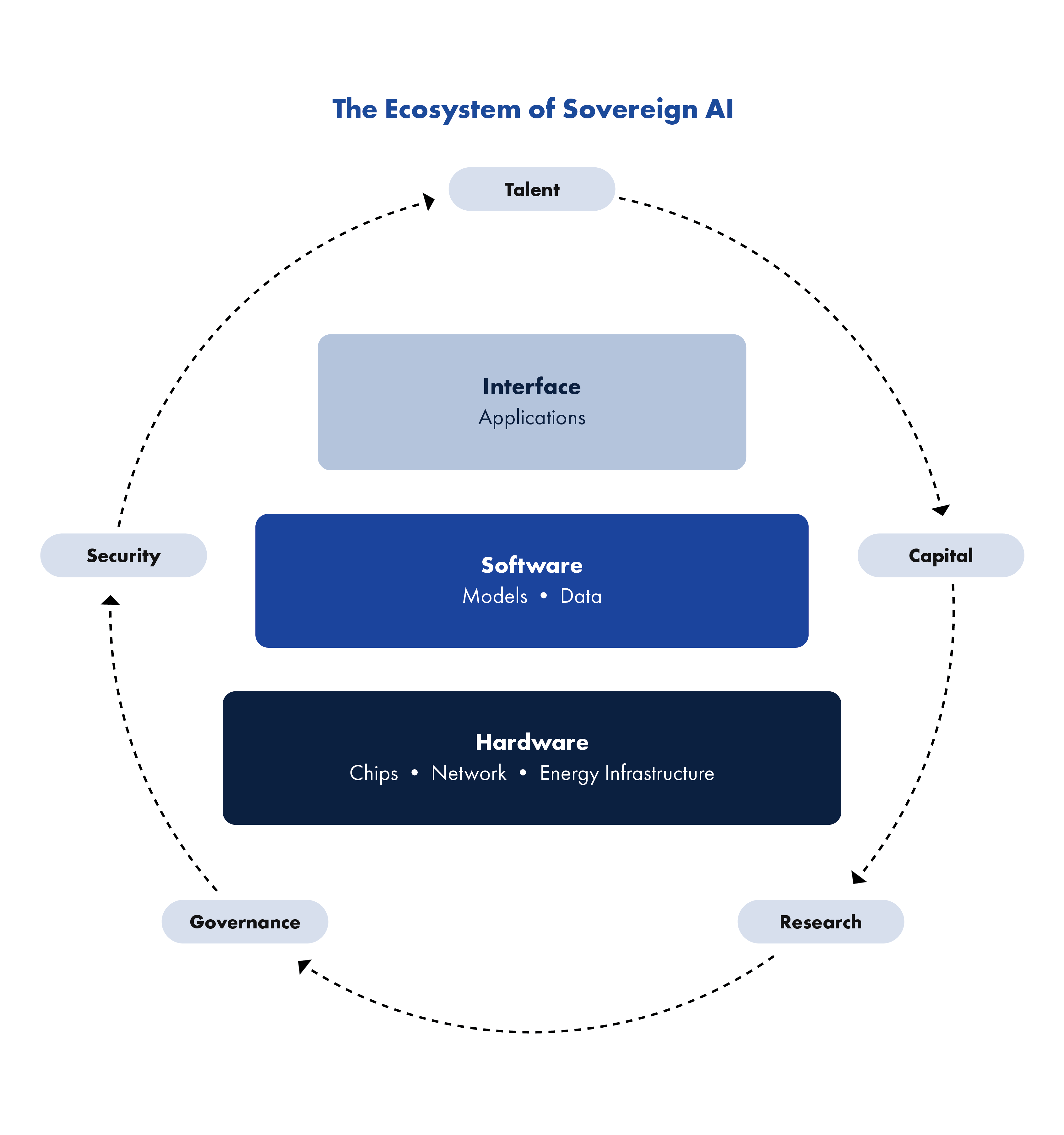
Broadly speaking, AI has been referred to as “five-layer cake,” involving energy, chips, infrastructure, models, and applications. Therefore, sovereign AI consists of multiple layers. I argue, however, that this concept should be broadened—understood as an ecosystem with overlapping components that draw on both hardware (e.g., chips and infrastructure such as physical compute, networking and energy) and software (e.g., models and data) for integration at the interface layer (e.g., applications). In addition to these critical layers, sovereign AI should be understood in the context of the tech’s full lifecycle, drawing on talent, capital, research, governance, and security. These latter components, in particular, are often neglected in policy discussions on sovereign AI.
A Two-Pronged Framework to Assess Sovereign AI
To help policymakers with having productive discussions on sovereign AI, I offer a two-pronged framework to more accurately assess the concept.: The first prong examines the factors that motivate states to pursue sovereign AI, and the second prong analyzes how states choose to integrate it across various layers of the AI technology stack.
Motivations: Why Do Countries Pursue Sovereign AI?
While not exhaustive, this piece outlines three primary motivations for states to pursue sovereign AI: national interest, technological sovereignty, and soft power.
- National interest-driven aims include strengthening national security and bolstering economic prosperity by protecting domestic industries, trade, and labor. This motivation also drives countries to advance AI research, models, and infrastructure.
- When countries are motivated by technological sovereignty, they hone in on seeking control over sensitive data, securing critical infrastructure, and avoiding reliance on foreign technology. In doing so, countries that pursue their own AI tech stack can prevent existing in an AI sphere-of-influence ecosystem that’s dominated by the major tech leaders of the United States and China.
- Leading countries like the United States and China are projecting soft power globally through different values-aligned AI standards and cultural leadership. In response, countries are pursuing varying degrees of sovereignty.
These motivations can also overlap across governments, which are weighing the trade-offs of indigenous development and the acquisition of components of the AI ecosystem.
Mapping Motivations Across Technical Layers: How Do Countries Pursue Sovereign AI?
The second prong of this framework focuses on the technical parts of the AI stack, emphasizing the trade-offs states face across its different layers rather than treating AI sovereignty as a singular objective. States may seek sovereignty in some components of the stack while remaining dependent on foreign providers in others. At the same time, governments are incentivized to both foster domestic AI capabilities and adopt AI technologies rapidly. For countries that are not already at the technological frontier, the pursuit of rapid AI adoption can outweigh the pursuit of AI sovereignty.
Applying the Framework: Country Case Studies
As defined above, sovereign AI is not a single layer but a multifaceted ecosystem with components that overlap and interconnect. It spans the hardware level—including chips, physical compute, networking, and energy infrastructure—the software level of models and data, and the interface layer where applications integrate these elements. Critically, this ecosystem must also be viewed through the lens of its full lifecycle, encompassing talent, capital, research, governance, and security.
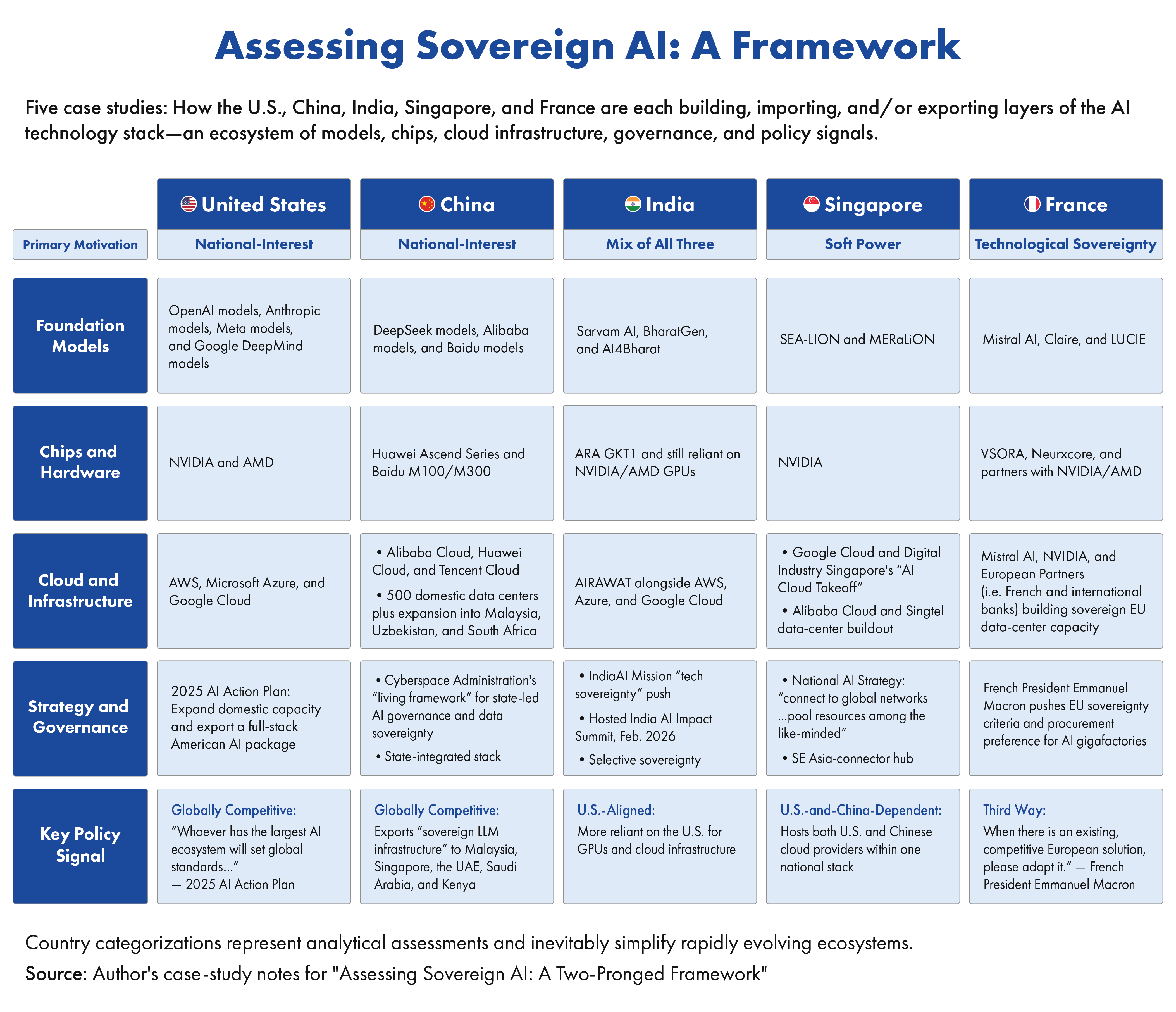
In addition to the narrative of two dominant AI stacks, namely the United States’ and China’s, this piece highlights other countries’ pursuits of sovereign AI, including France, India, and Singapore. These five short illustrative case studies, spanning geographic regions, draw on national documents and quotes from high-level leaders. Using the two-prong framework, I assess the countries’ primary motivations behind sovereign AI efforts and the extent to which they are building critical technical layers of the AI technology stack domestically or relying on foreign providers.
United States [Primary Motivation: National Interest]
The United States is promoting a “full-stack” AI strategy that positions it as a leader in domestic innovation and leverages its technology ecosystem for international exports. The AI stack includes leading model developers, such as OpenAI, Anthropic, Meta, and Google DeepMind, and it’s supported by advanced semiconductor firms, such as NVIDIA and AMD, as well as large cloud providers, such as Amazon Web Services, Microsoft Azure, and Google Cloud.
The United States’ 2025 AI Action Plan promotes bolstering the stack domestically by expanding data center capacity, investing in semiconductor manufacturing, scaling energy infrastructure, and fostering a skilled workforce while reducing dependence on foreign supply chains. In the International AI Diplomacy and Security pillar of the plan, the United States seeks to export a full-stack American AI technology package comprising hardware (chips, servers, accelerators), data center/cloud infrastructure, data pipelines, models, software, and applications. Overall, the plan emphasizes that AI dominance is a strategic asset: “Whoever has the largest AI ecosystem will set global AI standards and reap broad economic and military benefits.”
China [Primary Motivation: National Interest]
China is pursuing sovereign AI by integrating a state-backed stack that includes models, hardware, infrastructure, and governance. For example, leading model developers, such as DeepSeek, Alibaba (Qwen), and Baidu, are leveraging indigenous semiconductor efforts from Huawei (Ascend Series) and Baidu (M100/M300) as well as platforms like Alibaba Cloud, Huawei Cloud, and Tencent Cloud.
China is also actively working to export its domestic stack. For example, firms such as Zhipu AI are marketing “sovereign LLM infrastructure” to foreign governments by combining Chinese models with on-premise hardware deployments. This allows countries (e.g., Malaysia, Singapore, the United Arab Emirates, Saudi Arabia, and Kenya) to host AI systems locally while remaining dependent on Chinese technology. Notably, China holds nine of the 10 top spots for quality among Open Source models. Outside the growing 500 data center projects within the country, China continues to build data centers across countries in Southeast Asia (i.e., Malaysia), Central Asia (i.e., Uzbekistan), and Africa (i.e., South Africa).
In terms of AI governance, China’s Cyberspace Administration said the guidelines will “evolve as technology advances, serving as a ‘living framework’ to balance innovation with safety. The move marks a major step in China’s broader effort to standardize the use of generative and large-scale AI models across government, reinforcing state-led digital governance and national data sovereignty.”
India [Primary Motivations: National Interest, Technological Sovereignty, and Soft Power]
India is pursuing a hybrid sovereign AI strategy that emphasizes domestic capabilities while selectively leveraging foreign technology from the United States. For example, indigenous efforts include models from Saravam AI, a multimodal model for Indian languages; the government-backed BharatGen; and open-source ecosystems like AI4Bharat alongside emerging domestic hardware, such as the ARA GKT1 chip, and public compute infrastructure through AIRAWAT under the IndiaAI Mission. The IndiaAI Mission underscores “tech sovereignty” by investing domestically across compute capacity, datasets, startups, safety frameworks, and talent development. India also hosted the India AI Impact Summit in February 2026, marking the first large-scale global AI event in the Global South to discuss AI regulation, safety, and inclusive development.
At the same time, India’s tech stack relies on external providers, namely U.S. firms, including Amazon Web Services, Microsoft Azure, and Google Cloud, which underpin much of its cloud and model development ecosystem. Compared to China, India is more reliant on the United States for key components of the tech stack (i.e., GPUs from NVIDIA and AMD and AWS Cloud Infrastructure). This hybrid strategy reflects India’s pursuit of sovereign control over specific layers, such as data and language models, while depending on imported components of the global AI stack.
Singapore [Primary Motivation: Soft Power]
Singapore is pursuing a hybrid pathway to sovereign AI, integrating both U.S. and Chinese technology ecosystems while investing in regional innovation. In Singapore’s National AI Strategy, the government emphasized that the country must “connect to global networks” and “pool resources among the like-minded” to overcome AI issues, signaling interdependence as a strength.
Although Singapore relies on leading countries’ AI ecosystems, it is actively working to retain control over key governance, data, and applications. For example, Singapore created SEA-LION and MERaLiON—a family of open-source large language models designed to better represent Southeast Asia, especially its wide breadth of languages. When it comes to the hardware layer, Singapore lacks indigenous cutting-edge AI chips, but it is a semiconductor hub focused on mature-node manufacturing and global supply chain integration. At the cloud infrastructure layer, Google Cloud and Digital Industry Singapore launched a dedicated national program called AI Cloud Takeoff to accelerate AI transformation within 300 countries across the country. In addition, Alibaba Cloud and Singtel are rapidly developing data centers across Singapore.
France [Primary Motivation: Technological Sovereignty]
France is pursuing a “third way” on sovereign AI, leaning away from dependence on the U.S.-led tech stack and the Chinese state-integrated AI stack. Instead, France is investing in domestic capability-building across its full stack. It’s invested in models—such as Mistral AI, Claire (a collection of OpenLLM-France language models), and LUCIE (an LLM produced by the French tech company Linagora)—and emerging domestic chip design capacity through firms like VSORA and Neurxcore while partnering with NVIDIA and AMD. When it comes to the data infrastructure layer, Mistral AI, in partnership with NVIDIA and European infrastructure providers, is building large-scale AI data center capacity in Europe as part of a broader push toward sovereign AI. This effort can help Mistral move toward becoming a full-stack AI/cloud infrastructure provider while decreasing reliance on the U.S.-based hyperscalers.
In November 2025, at the Adopt AI Summit in Paris, French President Emmanuel Macron called for “sovereignty criteria to be included in the EU’s selection of AI gigafactories and for an EU preference in public procurement.” He said: “In China, you have a Chinese exclusivity; in the US, you have a US preference,” he said. “The European Union is the only place in the world where you have a non-European preference de facto.” The “third way” reveals France is pursuing controlled interdependence by supporting homegrown AI firms and European cloud capacity while continuing to use foreign chips and foundational technologies, primarily from the U.S.
Implications and Future Steps
The pursuit of sovereign AI is multi-faceted, spanning state motivations, components of the AI ecosystem, and various governance models. For U.S. policymakers, these findings highlight that sovereign AI is not a binary competition of complete technological self-reliance and total dependence on foreign AI ecosystems. Instead, countries pursue “partial sovereignty” over AI, which lies on a spectrum of strategic dependencies and selective control. The United States, in particular, can remain closely tied to allied AI ecosystems through critical chokepoints, such as advanced chips, cloud services, and models, even as partners work toward greater autonomy.
In addition, fragmented stacks will highlight issues like interoperability, regulatory divergence, and the tradeoffs of economic costs and innovation. Interoperability issues arise when different countries and companies build their own layers of the AI stack independently, making it difficult for systems to work together. This is especially salient in the national security domain. Across the globe, regulatory divergence arises as jurisdictions write their own AI rules, such as the EU AI Act, China’s algorithm registration regime, and the United States’ state-level rules. States will also need to decide whether to invest in domestic innovation across the various layers of the AI stack or rely on external providers and adapt to their standards.
Future research can expand the scope of country case studies to understand variations of sovereign AI. Concrete issues such as interoperability problems across fragmented stacks, regulatory divergence, and the economic costs of pursuing sovereign AI should be studied further. For Washington, the strategic challenge is not only competing with rivals but also shaping interoperable standards, trusted technology partnerships, and governance frameworks that keep U.S.-aligned ecosystems attractive, scalable, and hard to replace.
Acknowledgements
For her careful review, thoughtful comments, and constructive feedback, I would like to thank Emelia Probasco. I’d also like to thank Sophie Mayo for her excellent research assistance.